In the world of confectionery manufacturing, gummy candies are undoubtedly one of the fastest-growing categories in recent years. From classic gummy bears to functional vitamin gummies, I’ll take you inside the factory to explain the 10 core steps of gummy candy production.
What is a gummy candy production line?
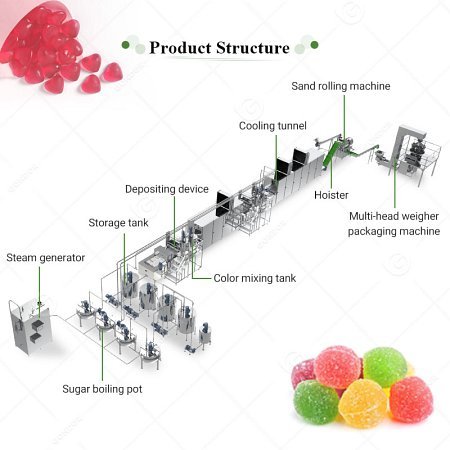
A gummy candy production line is an automated equipment system for the continuous and standardized production of gummy candy products. It’s not a single piece of equipment, but a complete process chain consisting of multiple steps including ingredient preparation, sol-gelling, sugar dissolving, cooking, mixing, pouring, cooling, demolding, surface treatment, and packaging. Through this system, factories can process sugar, syrup, colloids, flavorings, colorings, and other additives into gummy candy products with uniform shape, stable taste, and consistent appearance.
Compared to traditional manual or semi-manual production methods, modern gummy candy production lines emphasize stable production capacity, formula repeatability, hygiene control, and finished product consistency. For food factories, this not only means higher production efficiency but also lower human error, clearer process management, and product quality more suitable for large-scale market sales.
Step 1: Formula and Raw Material Preparation
The real starting point for gummy candy production isn’t starting the machines, but confirming the formula. Sugar, glucose syrup, water, colloidal system, acidulants, flavorings, and colorings must all be pre-designed in proportion to the target taste. For a more chewy product, the colloidal structure needs to be more stable; for a clearer, easier-to-unmold product, the control of solids and moisture content needs to be more precise. The more detailed the raw material preparation, the smoother the subsequent equipment operation.
Many factories blame problems on the machines, but in reality, instability in the first batch often stems from issues with the front-end weighing and formula logic. Modern gummy candy production lines use high-precision sensors to ensure that the solids content (Brix) error of each batch is controlled within 0.5%.
Step 2: Solving and Sugar Dissolving
Once the raw materials are prepared, one of the most crucial basic processes in the gummy candy production line begins: solving and sugar dissolving. Colloidal substances, such as gelatin or pectin, need to be fully dispersed under appropriate temperature and stirring conditions.
Simultaneously, sugar and syrup also need to be dissolved in the sugar dissolving pot. This stage may seem like simply “dissolving” the raw materials, but it determines whether the subsequent syrup will be smooth, free of lumps, and whether it will affect the flowability of the pouring.
Temperature control is key to the transparency of the gummy candy. Undercooking will result in a sticky texture, while overcooking will damage the colloidal structure.
Step 3: Heating and Cooking, Building the Gummy Candy Framework
Cooking is not just about raising the temperature; it involves continuous heating and stirring to achieve the appropriate concentration and state of the sugar syrup, providing the foundation for subsequent shaping. Cooking is a crucial step for a simple reason: undercooking will result in a soft and sticky finished product; overcooking can affect the texture, color, and flavor.
For gummies, the true “skeleton” isn’t formed in the mold, but rather begins during the cooking stage.
Step 4: Flavoring and Coloring
After the basic gummy system stabilizes, flavoring, coloring, and acidity adjustment become more meaningful. This is because the syrup at this point has good fluidity and uniformity, making it easier to achieve consistent mixing after adding flavoring ingredients. A mature gummy production line doesn’t operate on a “one-pot” basis; instead, it creates controllable modules for the later, more refined ingredient preparation. The benefits of this are obvious: faster flavor changes, greater recipe repeatability, and more consistent product color.
Step 5: Insulated Conveying to the Casting System
In actual production, this is the dividing line between “knowing how to make it” and “making it well.” The gummy syrup must maintain the appropriate temperature and flow state before entering the casting head; otherwise, stringing, blockages, uneven weight, or incomplete shapes will occur. Modern gummy production lines typically integrate insulated conveying with high-precision casting. Some systems emphasize casting accuracy and error control, aiming to make each gummy as similar in weight, size, and shape as possible.
Step 6: Mold Casting
Once the syrup stabilizes, it enters the casting stage. The casting machine, through multi-head discharge or servo control, precisely injects the syrup into the mold, forming various products such as bears, fruits, geometric shapes, and even filled or two-tone designs. Gondor’s gummy candy production line is no longer limited to traditional single-color products; it can now cover filled, 3D irregular shapes, and various other design requirements.
In other words, the mold system and casting system are not “accessories,” but rather the core components that determine the product’s differentiated appearance.
Step 7: Cooling and Shaping
After the gummy candy is injected into the mold, it is not yet formed. It still needs to pass through a cooling system to gradually lower the temperature and achieve stable shaping. This allows the gummy candy to form a more stable shape and internal structure in a controlled environment. If this stage is too fast or too slow, it can cause problems: the former may affect the surface condition, while the latter can easily prolong the production cycle and increase the risk of sticking.
Step 8: Demolding
The cooled gummy candy is smoothly ejected by a pneumatic ejector or robotic arm. At this stage, the gummies, though formed, still retain some moisture. If unmolding is difficult, even if the previous recipe and pouring were correct, deformation, edge breakage, sticking to the mold, and product loss will occur.
Step 9: Polishing and Coating
To prevent sticking and increase gloss, the gummies are polished in rollers. Some gummies are lightly oiled to make the surface shinier and reduce sticking; others are coated with sugar, acid powder, or polished to enrich the texture.
These processes are not just for appearance; more importantly, they improve the condition before distribution and packaging. Especially in high-temperature or high-humidity environments, anti-sticking treatment is almost never an option but a necessary condition to ensure the finished product can be packaged, transported, and displayed.
Step 10: Weighing, Packaging, and Finished Product Output
The final step is packaging. The gummies need to be left to stand in a controlled, low-humidity room for 24-48 hours to reach their final hardness before being sent to a packaging machine for sealing. Only at this stage does the gummies truly transform from a “semi-finished product” into a “marketable commodity.”
Gondor Machinery has a complete gummy candy production line that can link weighing, sorting, bagging or bottling, sealing and labeling processes, thereby reducing human contact and improving hygiene and efficiency.
Gummy production lines are not single-machine operations, but rather a continuous process chain from formula to packaging. Truly high-quality gummies rely not on a single “magical piece of equipment,” but on the stability of every step: accurate formula at the beginning, thorough cooking, precise pouring, proper cooling, smooth demolding, proper post-processing, and seamless packaging.
What should you pay attention to when purchasing a gummy candy production line?
When purchasing a gummy candy production line, the first thing buyers should focus on is not the appearance of the equipment, but whether their product goals are clearly defined. For example, do you plan to make gelatin gummies or pectin gummies? Single-color gummies, two-color gummies, or filled gummies? Is it small-batch trial production or continuous large-scale production? Different product structures and production capacity goals will have a significant impact on equipment configuration.
The second key consideration is the core process matching capability of the production line. Special attention should be paid to the cooking system, mixing accuracy, pouring accuracy, cooling conditions, and demolding stability. These are not abstract parameters, but key factors that directly determine whether the product can be made evenly, whether it is easy to stick together, whether the molding is complete, and whether the taste is consistent.
Third, the flexibility and expandability of the equipment are also very important. If the company plans to add flavors, add molds, make different shapes of products, or even upgrade to two-color or filled products in the future, then it should be understood at the initial stage of procurement whether the equipment supports future expansion.
Fourth, workshop conditions cannot be ignored. Gummy candy production has specific requirements regarding voltage, steam, cooling conditions, workshop temperature and humidity, and spatial layout. Especially in the cooling and post-processing stages, even the best equipment may fail to perform optimally if the workshop environment is not properly controlled.
Finally, it’s crucial to ensure the supplier truly understands the process, rather than simply selling equipment. A suitable supplier should be able to help you find a more suitable equipment solution based on your product positioning, target output, workshop conditions, and budget, rather than simply recommending a “generic configuration.”